
Free · nothing to sign up for
Obituary template — the format, and the words that go in it
An obituary follows a shape that has barely changed in a century, and knowing the shape is most of the work. Below is the standard structure, part by part, with the phrases families conventionally use, worked examples for six different situations, and a fill-in helper that assembles your answers into finished text you can copy or send straight into a printed program.
The standard format, part by part
Seven parts, in this order. Two or three sentences each is plenty; the whole thing is usually 200 to 450 words.
-
1. The announcement
Full name, age, town, and the date of death. Add the place if it matters to the family — at home, at the hospice, at the hospital.
Margaret Ann Doyle, 71, of Wheaton, Illinois, died on March 3, 2026, at home, with her family beside her.
“Died” and “passed away” are both standard. Put a nickname in quotation marks inside the full name: Robert “Bob” Lee Hastings.
-
2. The beginning
Date and place of birth, parents’ names, where they grew up, school.
Margaret was born on June 14, 1954, in Joliet, to Thomas and Ann Byrne. She grew up on the west side and graduated from Joliet Catholic in 1972.
One or two sentences. Maiden names are given in the mother’s name: “Ann (Kelly) Byrne”.
-
3. The life
Marriage, work, service, the place they lived longest, what they were known for. This is the middle and the longest part.
She married Patrick Doyle in 1976. She taught third grade at St. Michael’s for thirty-one years and led the parish altar society for twenty.
Three to six sentences. Dates and job titles are worth checking; nobody minds a plain sentence, everybody notices a wrong year.
-
4. What they loved
The garden, the lake, the Sunday table, the team, the choir. One sentence of this is worth a paragraph of achievements.
She loved her garden, the Cubs, a full table on Sunday and any child who needed a book.
This is the line people read twice. It is also the line that makes the obituary sound like a person rather than a record.
-
5. Survived by
Spouse, children with their spouses in parentheses, grandchildren, siblings, then “and many nieces, nephews and friends” when the list runs long. Then those who died before.
She is survived by her husband, Patrick; her children, Thomas (Elena) Doyle and Kathleen (Mark) Reilly; her grandchildren, Ann, Patrick and Claire; and her sister, Mary Byrne. She was preceded in death by her parents.
Ask each person how they spell their own name. Partners, stepchildren and lifelong friends are listed in the words the family uses.
-
6. The service
Day, date, time, place and address; visitation if there is one; burial; reception.
A funeral Mass will be held at St. Michael Church, 310 South Wheaton Avenue, on Saturday, March 7, at 10:00 a.m. Interment will follow at Assumption Cemetery.
Confirm the time and address with the funeral home or the church before this is printed anywhere.
-
7. In lieu of flowers
A charity, a fund, or an instruction the person would have given.
In lieu of flowers, donations may be made to the St. Michael School library.
“Plant something.” “Take a kid fishing.” “Read to a child tonight.” These are now as common as charities, and families remember them.
Fill it in and read it back
Answer what you can and skip the rest — every part is optional, and the text updates as you type. Nothing is sent anywhere: this runs in your browser, and the words stay on your screen until you copy them.
Your obituary
0 words
Start filling in the form and the obituary appears here, one paragraph at a time.
Nothing here is sent to us or saved on our servers. “Put this in a printed program” carries your words into the editor in this browser, where the name, the dates and the service details are already filled in.
How long an obituary should be
For a printed funeral program, 200 to 350 words sits comfortably beside a photograph on one page; the eight- and twelve-page programs hold about 500, with the rest continuing on a second page headed “Her Life” or “His Life”. For a funeral home website there is no limit and 400 to 600 words is common. For a newspaper, which charges by the line or the column inch, families usually print the announcement and the service details only — often 80 to 120 words — and put the full text in the program and online.
Length is not the measure. An obituary of 180 words with one true sentence about who the person was reads better than 600 words of job titles. Write it, read it aloud once, and cut whatever you would not say to their face.
Wording for the parts that are hard to write
A long illness: “after a long illness”, “after a long illness borne with more grace than the rest of us managed”, or nothing at all. You never have to name a diagnosis. A sudden death: “died suddenly” or “died unexpectedly” is complete; the details belong to the family. An estranged relative: list them or do not — nobody is owed a line in an obituary. A partner who was never a spouse: “her partner of twenty years, Michael”. A second marriage: both are named, in order, with dates.
Where a fact is uncertain, leave it out. An obituary with a gap is ordinary; an obituary with a wrong year is the thing a family gets letters about.
Where the obituary goes once it is written
Three places, usually: the funeral home’s website, the newspaper notice, and the printed program handed out at the service. The program is the copy people keep — it goes in a Bible, a drawer, a memory box, and it is read again at anniversaries.
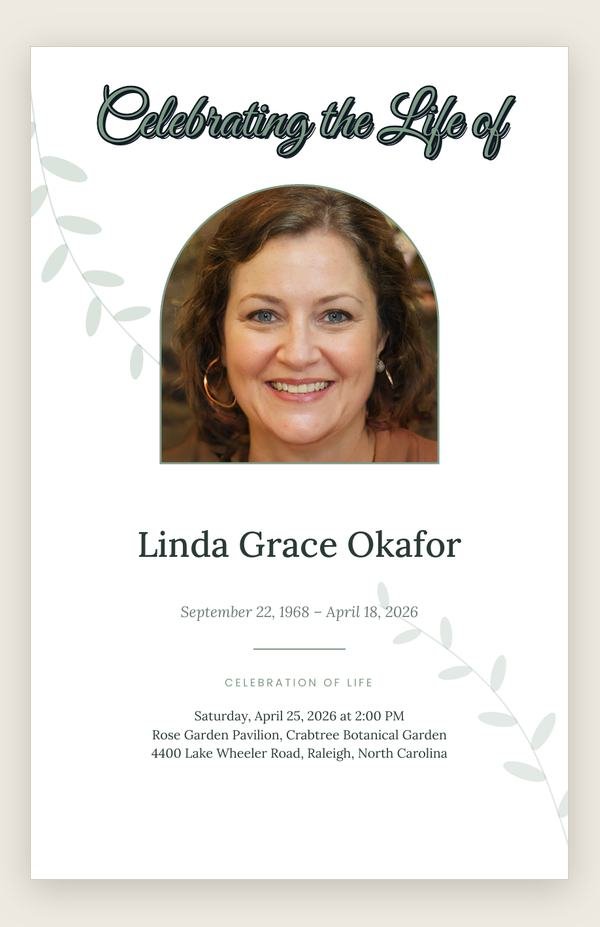
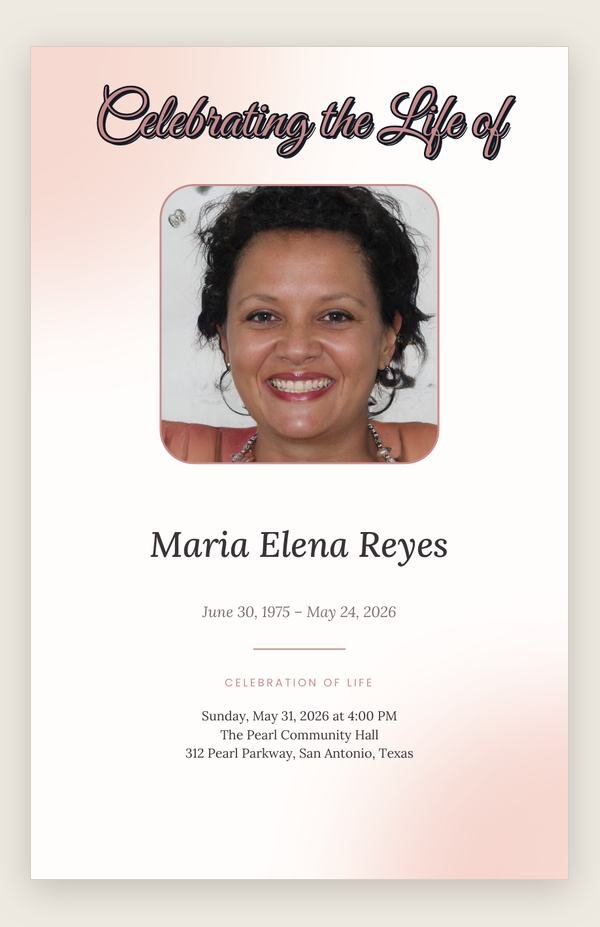
If you write the obituary here, the button under the helper carries it — with the name, the dates and the service details — into a printed program: choose a design, see every page take shape as you type, and download a print-ready PDF for a copy shop or your own printer.
Six situations, with a worked example each
The shape stays the same; a few sentences change. Each page below has the wording for that situation and a complete example to adapt.
- Writing an obituary after a sudden death
How to write an obituary when the death was sudden or unexpected: what to say about the cause, what to leave out, and a complete worked example.
- Writing an obituary after a long illness
How to write an obituary after a long illness: the conventional phrases, whether to name the illness, thanking the carers, and a complete worked example.
- Writing an obituary for a veteran
How to write an obituary for a veteran: where to find the service record, how to write rank, unit and decorations, the honors, and a complete example.
- Writing an obituary for a child or a young person
How to write an obituary for a child, a teenager or a young adult: what to include when there is no career or marriage, and a complete worked example.
- Writing an obituary when there is no spouse or children
How to write an obituary for someone who never married or outlived their family: who to list as survivors, and a complete worked example.
- Writing an obituary for a blended family
How to write an obituary for a blended family: naming both spouses, listing stepchildren, and handling an ex-spouse. With a complete worked example.
When the words are ready, the program takes ten minutes
The obituary is the hard part. Choose a design, and the same details make the program, the prayer cards, the bookmarks, the sign at the door and the thank-you cards — print-ready, in printing order, with bleed and crop marks for a copy shop or exact size for your own printer.

$29 for the program, $59 for the complete set — one payment, files in minutes, nothing shipped. Start the program
Questions families ask
- What is the standard obituary format?
- Seven parts in order: the announcement (name, age, town, date of death); the beginning (birth, parents, school); the life (marriage, work, what they were known for); what they loved; survived by, then preceded in death by; the service details; and a closing line about flowers or donations.
- How long should an obituary be?
- 200 to 350 words for a printed program, 400 to 600 for a funeral home website, and 80 to 120 for a newspaper notice that charges by the line. Cut anything you would not say to the person's face.
- Do I have to say how the person died?
- No. “Died” on its own is complete. “After a long illness”, “died suddenly” or “peacefully at home” are the conventional phrases when a family does want to say something, and none of them require a diagnosis.
- Who is listed in the survivors, and in what order?
- Spouse or partner first, then children with their spouses in parentheses, then grandchildren, then siblings, then parents if living. “And many nieces, nephews and friends” closes a long list. Those who died first go in a separate sentence beginning “preceded in death by”.
- Is this obituary template free?
- Yes. The format, the examples and the fill-in helper are free and nothing is stored — the text is assembled in your browser. Printing it into a funeral program with a matching prayer card, bookmark and thank-you card is the paid part, from $29.
- Can I write the obituary in my own voice?
- Yes, and the best ones are. Keep the facts exact — names, dates, the service — and let the tone be yours. Celebration-of-life obituaries are often written the way the family talks.
This page is offered for informational purposes only. It is not legal, medical or funeral-directing advice, and no warranty is given as to its accuracy, completeness or fitness for any particular purpose. Where a detail matters — a date, a rank, a service time — confirm it with the funeral home, the church or the family before it is printed.