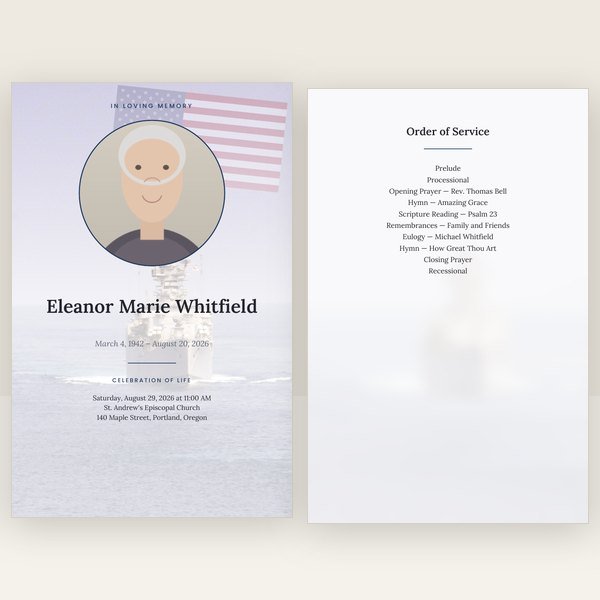
Navy Fleet
Ships in line on a calm blue sea, with the Stars and Stripes soft in the sky. For a sailor, a veteran, or anyone who served.
Create yours nowMilitary funeral program
When the person who died is remembered first as a soldier, sailor, airman, Marine, Coast Guardsman or Guardian, the program should say so precisely: the rank, the unit, the deployments, the decorations. This page is about getting those details right and setting the honors ceremony out clearly, in a design that carries the flag.
Navy Fleet makes the program, prayer card, bookmark, welcome sign and slideshow in one setting.
A service history, a tributes page and a page of photographs from service and civilian life fit comfortably in the eight-page booklet.
The discharge papers — the DD Form 214 for most service members — are the family's best source. They give the rank held at separation, the dates of service, the last unit, and the decorations and campaign medals awarded, which is the list most families want printed. Write the rank in full on the cover rather than abbreviated ("Master Sergeant", not "MSgt") so guests from outside the service read it easily; abbreviations are fine in the obituary once the full form has appeared. For a retiree, "(Ret.)" after the rank is customary. If the person served in more than one branch, list each with its dates.
Decorations are usually listed in order of precedence, highest first, on a line of their own under the service details or on a page headed "Military Service". A unit, a ship or an aircraft type, and the places served — Korea, Vietnam, Germany, the Gulf, Iraq, Afghanistan — belong in the obituary as part of the story, with the years. Where the family is unsure of a detail, it is better to leave it out than to guess; the funeral director or the branch's casualty assistance office can often confirm.
Military funeral honors are rendered by an honor guard from the service member's branch, sometimes with a veterans' organization assisting. At the committal the flag is draped over the casket or folded beside the urn. If a rifle detail is present, three volleys are fired. Taps is sounded by a bugler, or by a ceremonial bugle where a live bugler is not available. The flag is then lifted, folded by two members of the honor guard into the triangular fold, and presented to the next of kin by a member of the honor guard who kneels before them, with the words of thanks on behalf of the President and the branch of service. For a service member who died on active duty, or for a retiree of senior rank, the honors may be fuller — pallbearers from the unit, a color guard, a chaplain — and the funeral director will tell you what has been arranged.
In the program, the honors are listed under the committal heading in the order they will occur, with a short line beneath explaining what guests will see, so that no one is startled by the volley and everyone knows to stand for Taps. We are not affiliated with or endorsed by the U.S. government or any branch of the armed forces; the description above is what families commonly see, and the honor guard and the funeral director decide the ceremony on the day.
Service photographs are often the ones a family treasures: the boot camp portrait, the photo beside the aircraft or on the deck, the homecoming. The eight-page program has a photo page for them beside civilian photos, and a small grid of photos on the back. The memorial slideshow takes up to forty more and plays full screen at the reception; the welcome sign on an easel at the chapel entrance carries the service portrait and the flag. All of it is made from the details entered once for the program. Printing is explained in how to print a funeral program, and wording for each section is in what to include.
Rank, unit, decorations and the honors ceremony, set out clearly in a design that carries the flag.
Create the programDigital download only. Free corrections for 30 days. All sales are final.